2. Enhance Boss Fight Training
Date: 2026-02-23 · Model: boss_fight_mix_final.zip
Table of Contents
Changes from Baseline
To allow the agent to “run-and-gun” and increase its DPS during the boss fight, we made two key changes:
- Always-Fire Action Space: Modified
ACTION_TABLEso every movement action includes theB(Fire) button. - Boss State Mixing: Used a custom state file (
states/Level1_x3048_step921.state) so that episodes randomly start from either the beginning of Level 1 or right before the Boss.
Results
Test Runs (Level 1 Start)
We tested the final model starting from the beginning of Level 1.
| Metric | Run 1 | Run 2 |
|---|---|---|
| End Reason | game_over | game_over |
| Score | 0 | 0 |
| Total Reward | 106.5 | 67.15 |
| Distance | 1983 | 1455 |
Test Run (Boss State Start)
We also tested the agent starting directly from the Boss state.
| Metric | Run 1 |
|---|---|
| End Reason | game_over |
| Score | 99 |
| Total Reward | -89.8 |
| Distance | 3072 |
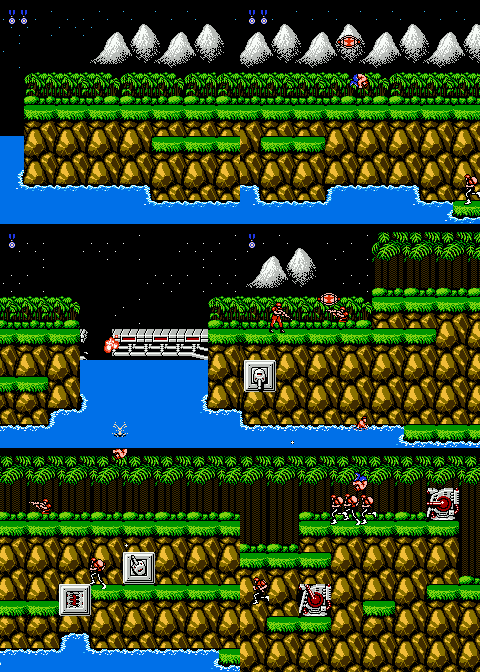
Gameplay Recording
Analysis: The “Glued Trigger” Failure
The agent performed significantly worse than the baseline, registering a Score of 0 when starting from the beginning of the level. A score of 0 in Contra means the agent killed zero enemies.
Why did this happen?
The issue stems from how the NES hardware registers button presses, combined with a bug in our ContraWrapper.step function.
1. The Action Wrapper Bug In contra_wrapper.py, the skip loop executes the chosen action for 4 consecutive emulator frames. A comment suggested it would hold for 3 frames and release for 1, but the code actually passes the nes_action for all 4 frames:
2. The Contra Weapon Mechanic With our new “always-fire” action space, the agent always chooses an action where B=1. Because step() perpetually holds the B button down without ever releasing it between actions, it mimics a player physically gluing down the B button.
In Contra, the default rifle is semi-automatic. If you hold the B button down, the character fires exactly one bullet and never fires again until you release and press it again.
Conclusion
By attempting to give the agent constant “run-and-gun” abilities, we accidentally created an agent that fired exactly once at the start of the level and never again. Without the ability to shoot, the agent was quickly overwhelmed by enemies (Distance ~1500-2000) and completely annihilated during the boss fight (yielding negative rewards).
Lesson Learned: Test Actions Before Training
This failure cost us an entire training run (~32M timesteps). The bug could have been caught in minutes with a simple action sequence test. Going forward, every time we modify the action table or wrapper behavior, we should verify the actions actually work before committing to a long training run.
One approach is a lightweight beam search over the action space — brute-force a short sequence of actions and check if the game state progresses as expected (e.g., score increases, enemies die, distance advances). This is reminiscent of Tom Murphy’s learnfun & playfun project, where:
- learnfun identifies valuable RAM addresses correlated with “winning” (e.g., score, distance, lives)
- playfun uses beam search to brute-force the action space, optimizing those RAM addresses to play NES games without any neural network at all
While we use PPO instead of beam search for the actual agent, the testing phase could benefit from this philosophy: define success metrics from RAM, then verify that our action space can actually move those metrics in the right direction before investing GPU hours into training.